
Google Ads for DTC Brands: 6 Reasons Your Account Can't Scale

.avif)
.avif)
.avif)
Ask your Google account one question: what does it cost to acquire a net-new customer? Not the blended return that folds in everyone placing their fourth order, but the real cost of a first-time buyer who had never purchased from you before.
We've audited Google accounts for more than 200 DTC brands over the last 18 months, and almost none of them can answer that question cleanly. Not because the number looks bad, but because the data to calculate it was never there. The account was never built to tell a first-time buyer apart from a loyal repeat customer, so every branded click, every conversion, and every line on the dashboard gets read as if those two people are worth the same to you. They aren't.
Google works less like a second growth engine sitting next to Meta and more like the capture layer for everything else you're already doing. Your Meta ads, your creator content, your organic, your word-of-mouth, all of it generates demand. Google mostly catches the people that demand already warmed up, at the moment they go searching for you.
Run Google like a demand engine and you'll credit it for sales that were always going to close, starve the campaigns that actually drive new customers, and cap how much you could profitably be spending, all while the dashboard tells you everything is fine.
That misread is expensive, and it's also the opportunity. Google is usually a brand's single biggest structural mess, and a structural mess is the good kind of problem to have, because you can fix most of it without spending another dollar.
This article covers how to see the channel clearly and run it like the capture layer it is: what most DTC brands get wrong about Google, what a broken account actually costs you, when Google deserves budget and how much, and the six problems draining most accounts today, with the fix for each.
What Most DTC Brands Get Wrong About Google Ads
Every dollar you invest in marketing does one of two jobs:
- it generates demand, or
- it captures demand
These are different jobs, and they mostly belong to different channels. Getting Google wrong almost always starts with confusing the two.
Meta generates demand. So do your creators. Someone is scrolling, not thinking about your product, didn't wake up wanting it, and a piece of creative makes them want it anyway. That is demand generation—manufacturing intent where none existed a second ago.
Google mostly does the opposite job. It captures the people your demand generation already warmed up (aka your Meta ads, your organic content, your creator videos, your word-of-mouth), at the exact moment they stop being passive and go searching. By the time someone types your brand into Google, the wanting has already happened somewhere else. Google is standing at the end of that journey, catching them.
The mistake almost every brand makes is running Google like a second demand engine and then judging it on a blended return. That number looks great, because a large share of those Google conversions were people who were always going to buy anyway.
But Google didn't create those sales. The channel just stood at the finish line and took credit for them. The more you scale into that misread, the better the dashboard looks, because you're paying to be the last click on demand you already generated somewhere cheaper.
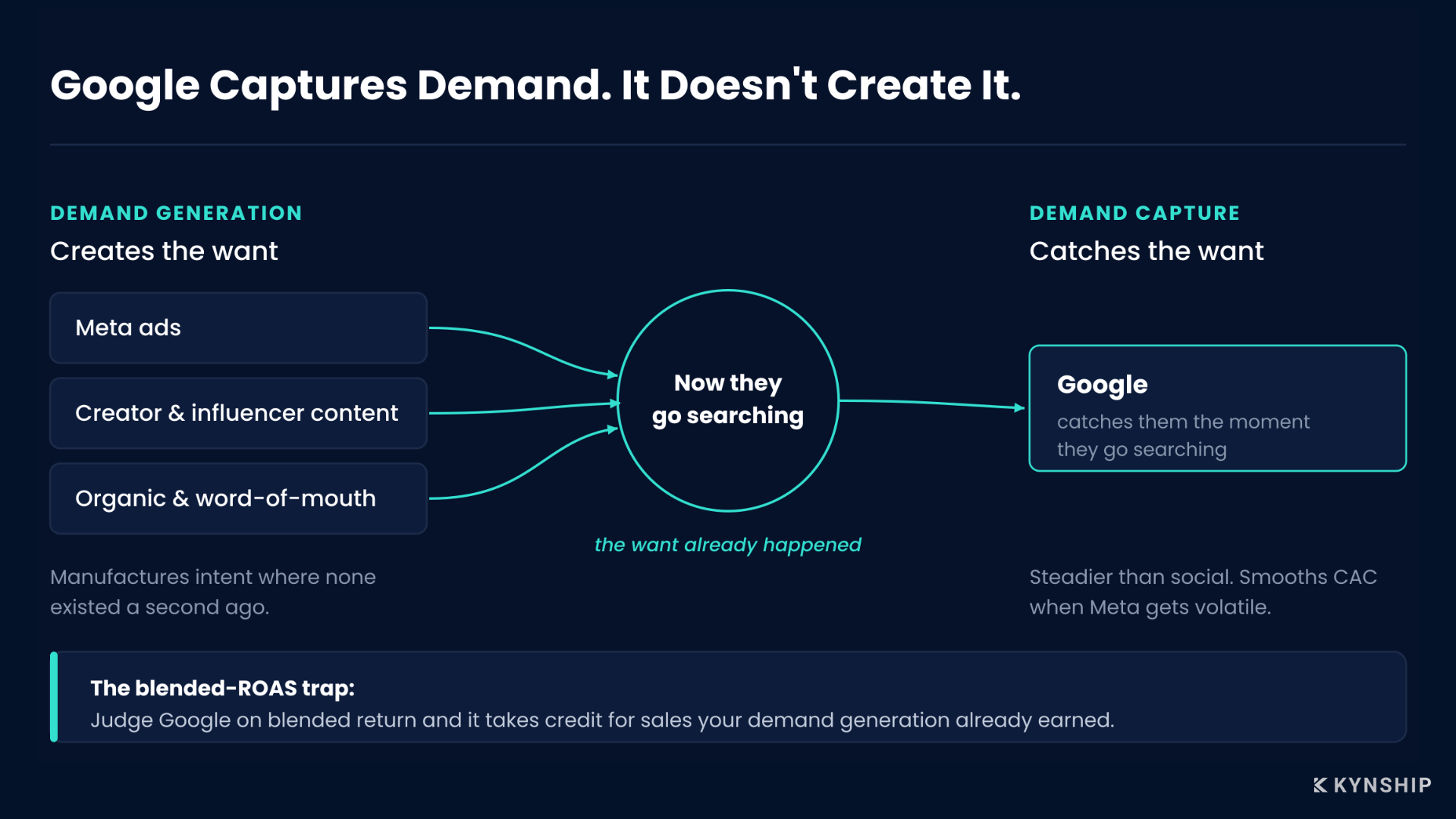
None of this makes capture a consolation prize. Search demand is steadier than social, so Google smooths out your acquisition cost on the weeks Meta gets volatile, and it defends your brand at the moment of highest intent, right before the sale. Capture is genuinely valuable work.
The problem is running the channel without knowing that's the job it's doing, because once you name the job, every structural decision downstream gets easier: what to isolate, what to hold to a stricter standard, and where a reported win is real versus borrowed.
The Real Cost of a Broken Google Ad Account
When we point out the waste in a Google account, the number that gets attention is the obvious one: the spend lighting itself on fire every month. On the accounts we audit, that's often $10,000 to $15,000 a month going toward clicks the brand would have won for free or customers it already owned (yes, you read that right). That money is real, but it isn't the whole cost.
The whole cost also needs to include what that broken structure costs you in growth you never see. Every dollar pointed at the wrong campaign, every conversion the account can't classify, every audience sitting unused caps how much you could profitably spend.
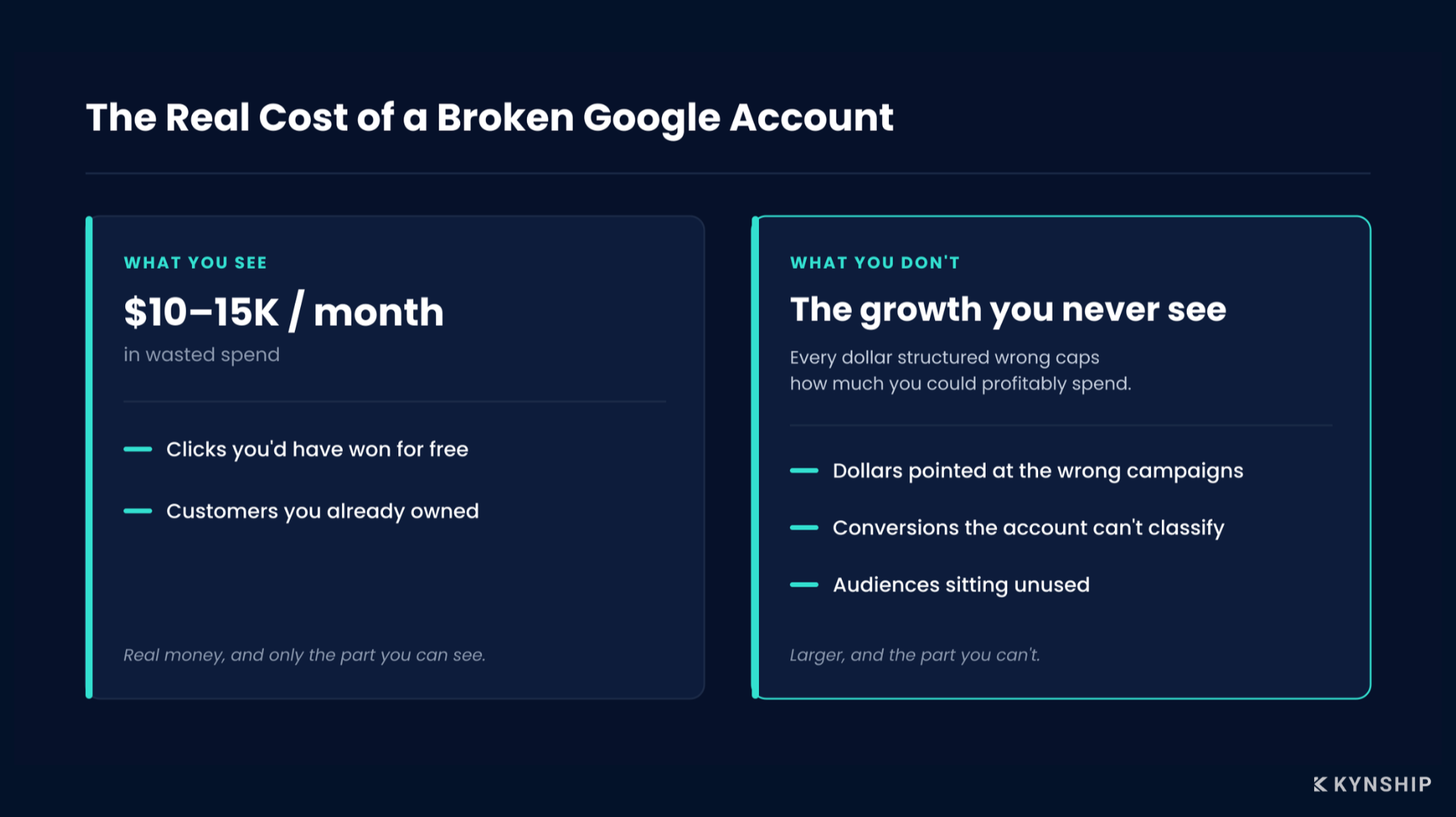
You can't scale into growth you can't measure, and a blind account holds your spend below the level its real performance would justify.
This is why the new-customer question matters as much as it does. If your account can tell you cleanly what it costs to acquire a first-time buyer, you're in rare company, and you can scale with real confidence. If it can't (and for most brands it can't), then "scale Google" doesn't mean what you think it means. You're not scaling, you're pointing a bigger budget at a number you can't trust.
How Much Budget You Should Give to Google Ads
You’re gonna hate us, but: It depends. If you have to have a number, an 80/20 Meta-to-Google rule of thumb, but resist the urge to run to a fixed split. Let efficiency lead instead.
- Hold branded search and shopping to a high return, in the range of 15 to 20x for most brands and closer to 8 to 10x if a real share of your discovery happens on marketplaces like Amazon or retail
- Hold non-brand prospecting to the same new-customer target, acquisition math, and order-value target you already hold Meta to
Then spend the next dollar wherever it earns the most, and let the ratio land where it lands.
That is what "efficiency leads the budget" looks like in practice, and it's the difference between a channel mix you manage and one you guess at. When we started with Hold Up Displays, a manufacturer selling through its own storefront and Amazon, the blended numbers looked healthy, but the channels underneath weren't pulling even weight.
Google and Amazon were being held to targets well below where they should have been, while Meta was held to a stricter standard than it needed. Meta looked like the star, while in aggregate the brand was overpaying for the same customers and the one channel with real headroom was the one being throttled.
We set an efficiency target for each channel individually, tied to the brand's real contribution margin. On Google, that meant separating brand from non-brand and holding each to its own standard. Once the soft targets were gone, the account stopped overspending to reacquire existing Amazon and Google customers and could put real weight where the headroom actually was. Over the following twelve months, Hold Up Displays scaled ad spend 41% and got more efficient while doing it, growing total revenue 43%.
👉 Learn more about how Hold Up Displays scaled revenue by 43% in 12 months while maintaining efficiency.
The 6 Problems Hiding in Most Dtc Google Accounts (And How to Fix Them)
Across the audits we run, we the same six problems show up again and again, and every one of them either hides your true cost to acquire a new customer or caps how much you could profitably spend. They're structural, they're common, and they're fixable.
1. Branded search bleeding across campaigns
Your brand terms, the searches where someone types your company name, should live in one walled-off place. In most accounts, they just…don't. They're eligible to show and spend across a handful of campaigns at once, which means brand conversions are padding the numbers everywhere.
That's a problem because brand always converts well. Wherever those conversions land, they inflate that campaign's return and bury the real cost of acquiring a new customer underneath a pile of people who already knew you. Trying to read a prospecting campaign while brand bleeds into it is like judging a billboard while someone stands directly in front of it handing out flyers. You can't tell what's actually working.
The fix
Brand should live in exactly two campaigns: one isolated branded search campaign and one isolated branded shopping campaign, walled off from everything else. Branded shopping specifically is the most overlooked piece here. It tends to carry the highest new-customer rate of anything in the account, and almost nobody runs it as its own dedicated campaign.
2. Paying to reacquire customers you already own
With no audience exclusions in place, every branded click gets treated identically. A first-time buyer and a ten-time repeat customer cost you the same amount to "acquire," except you already paid to acquire one of them, probably years ago.
It gets worse when your brand pulls up organically anyway. On one account we looked at, the brand name surfaced organically around 97% of the time with almost no competition on the term, so most of that brand spend was buying clicks from people who would have found the site and bought for free.
The cuttable waste on brand alone came to roughly $12,000 to $14,000 a month. This doesn't mean turning brand off entirely. Branded spend can be genuinely incremental as the final touch that closes a sale. It means you should know which it is rather than assuming.
The fix
Add real exclusions so you stop paying full price to reach customers you already own. Then prove brand is incremental instead of guessing:
- run a holdout test
- turn branded spend off in a controlled window
- watch what actually happens to total sales
Sometimes brand is more incremental than you expected. Sometimes you learn you've been paying to be the last click on sales you'd have won regardless.
3. Non-brand whack-a-mole
This one shows up when several non-brand campaigns are all bidding on the same queries. Scale one and it simply steals volume from another. Attribution reshuffles, the dashboard shifts around, everyone feels busy, and total growth doesn't move.
It's the arcade game. You push one campaign's budget down and the same customer pops up in a different campaign. You're not creating demand, you're relocating it, and paying management time to watch it move.
The fix
Segment non-brand shopping by product line or collection so each category can be bid and scaled on its own. Instead of one giant blob where campaigns cannibalize each other and you can't tell what's growing, you get clean, separable reads you can actually push budget into.
4. PMax over-reliance
Performance Max tends to eat most of the budget while running as a black box. No ad-group control, no audience control, little visibility into where the money actually goes.
Two things make that expensive.
- First, PMax delivers something like 95% of its results through shopping anyway, which you can run yourself with far more control through a standard shopping campaign.
- Second, it flatters itself, skewing toward retargeting existing customers who were going to convert regardless, then taking the credit. It looks like it's performing when it's mostly claiming easy conversions in a box you can't see into.
The fix
Pull brand out of PMax and rebuild standard search and shopping with real exclusions. At most spend levels, a properly built standard shopping campaign beats PMax on the metric that actually matters, new customers you can see, segment, and control.
5. No audience infrastructure
Your customer lists are your most valuable first-party signal, and in most accounts they're missing, tiny, stale, or loaded "on observation" and never actually used. One account we saw had over a thousand audiences available and only a few dozen switched on.
Part of this is a trap many brands miss: Google audiences expire at 18 months, so the lists you built back in 2022 are simply gone, and observation-only audiences just sit there gathering data nobody acts on. You're holding the signal that would let you treat a stranger and a recent buyer differently, and spending as if you don't have it.
The fix
Auto-import your customer lists with a nightly sync so they stay fresh, layer every audience in on observation, then apply bid modifiers by segment: 30- and 90-day purchasers, all-time buyers, purchase-count tiers, lifetime-value tiers.
Right now Google bids the same on someone who's never heard of you and someone who bought last week. Audience bidding lets you bid up for the new customer who just saw your Meta ad and is now searching you, and bid down for the repeat buyer you don't need to pay full price to reach again. Most of this fix costs nothing but the time to set it up.
6. Broken conversion tracking
Everything above sits on top of this one. If the signal telling Google what a conversion is happens to be wrong, every optimization downstream is reacting to bad data.
It breaks in two directions.
- The account either underreports purchases, often by pulling conversions from GA4 instead of a clean source, which can undercount by 15 to 40% and make a channel that's genuinely working look like it's failing so you starve it.
- Or it counts the wrong thing entirely: "all converters" audiences that tag anyone who fired any event, viewed a product, added to cart, as a purchaser, which trains the algorithm to go find more people who will never buy.
We audited one brand doing about $10.8M a year whose Google account showed on the order of a thousand total purchasers. At that revenue that isn't just low, it's mathematically impossible. The account wasn't tracking purchases correctly, and the large majority of recent branded-shopping visitors had no classification at all.
The fix
Move to Shopify auto-import for the highest match rate, and make "purchaser" mean an actual Shopify purchaser, a real person who bought, not anyone who fired an event. While you're in there, turn off auto-apply recommendations. They're built to grow Google's revenue, not your profit.
The Bottom Line
Google captures demand you already paid to create. Run it on purpose and it steadies your acquisition cost when Meta gets volatile and defends you at the moment of highest intent. Run it blind and it quietly takes credit for sales that were always going to close, while capping the spend your real performance could support. The difference between those two outcomes is almost entirely structural.
The tell of a healthy account is simple: it can tell you what a net-new customer costs. When it can, every decision downstream gets easier, which campaigns to scale, where to set bids, how much budget Google has earned. When it can't, you're not scaling, you're pointing a bigger budget at a number you can't trust.
If you want help turning your Google account into a capture layer you can actually read, with every channel tied back to contribution margin and net profit, that's the work we do. At Kynship, we help DTC brands from $2M to $100M grow new customers profitably, reverse-engineering the plan from top and bottom-line goals, building the creative that feeds demand, and scaling acquisition within real financial guardrails.
Click below to book a call with us, and we'll show you what your account is really telling you.
The 10 Eccommerce Tools We Use To Produce 3,000+ Ads Per Month
Six ecommerce tools and four AI workflows we use to produce 3,000+ ads per month across our DTC clients. Pricing, features, and how we use each one.

Ecommerce SMS Marketing Guide for DTC Brands
Not all ecommerce SMS marketing flows drive real results. Learn which flows genuinely increase returning customer revenue, which ones just inflate your dashboard, and how to tell the difference.
Bi-weekly tips to reduce your CAC
Join thousands of DTC operators and subscribe to Cut the CAC for insights from the Bottom Line Podcast and Kynship's growth strategies.



We use cookies to optimize our website and your experience with Kynship. But, like our democracy, you're in control. View our Privacy Policy for more information.

Privacy is important to us, so you have the option of disabling certain types of storage that may not be necessary for the basic functioning of the website. Blocking categories may impact your experience on the website. More information