
Ecommerce SMS Marketing Guide for DTC Brands

.avif)
.avif)
.avif)

Our DTC ecommerce clients performed really well over this last Black Friday, increasing revenue by an average of 28% in a tough year for the industry.
And while they were successful, we say the same trend we've been seeing for years: ad costs were higher and efficiency has gone down.
This trend represents the defining pressure on DTC brands right now. Paid ads are getting more expensive and less efficient at the same time. The brands that stay profitable through this are the ones that can make each customer worth more after the first purchase. When returning customer revenue goes up, you can afford to pay more to acquire the next customer. When you can afford to pay more, your ads can run harder. Retention is what sets the ceiling on how aggressively you can grow.
SMS is one of the best tools at your disposal for increasing returning customer revenue. For most brands, it's also the one running most on autopilot. Ecommerce SMS marketing flows are often built during onboarding and then never looked at again. SMS campaigns are often sent at random. And the numbres on your Klaviyo dashboard will usually look reasonable enough that nobody asks questions.
But these numbers can often be misleading. When Klaviyo says your SMS drove $X in revenue, it's counting every purchase made within a set window after a message was sent, including customers who were already planning to buy, who clicked a Meta ad instead, or who had items sitting in their cart when your campaign landed. The dashboard takes credit. Your actual business results don't change.
In this guide, I'm going to show you how to evaluate your SMS marketing and build a system that will reliably increase LTV and returning customer revenue.
This guide is brought to you by Kynship, a DTC growth agency that helps ecommerce brands between $2M–$100M break through growth plateaus by reverse engineering from both top and bottom line goals, building scalable creative systems, and driving new customer growth profitably. Our track record includes scaling Purdy & Figg from $500K to $50M in 3 years and growing WildBird’s revenue by 10x over 2 years while maintaining 5 aMER, 30% CM, and 17.5% profit.
Evaluate SMS Like a Financial Lever, Not a Channel
Most brands evaluate their SMS program by opening Klaviyo and looking at attributed revenue. The number looks good, the team moves on, and nobody digs deeper.
The problem is that SMS attributed revenue tends to overstate actual impact.
That’s because of how attribution windows work. Klaviyo’s default SMS attribution captures any purchase made within a set window after a message is received or clicked. A customer who got an SMS on Tuesday, ignored it, saw a Meta ad on Thursday, clicked through, and purchased your product still gets attributed to SMS. So does the customer who was already on your site with items in their cart when the campaign hit.
Of course, this doesn’t mean SMS isn’t contributing. But it does mean the number on the dashboard isn’t telling you how much of that revenue SMS actually created versus how much it contributed to.
If you’re running your business on aMER, contribution margin, and new versus returning customer revenue (the way we recommend in our financial forecasting guide), you need to hold SMS to the same standard.
The Metric That Actually Matters: Incremental Returning Customer Revenue
The question to ask about your SMS program isn't “How much revenue does Klaviyo say it generated?”
It’s “Is SMS measurably increasing returning customer revenue beyond what email and organic behavior would have produced on their own?”
This matters because of how Kynship’s financial system works. Your financial model determines what you can afford to pay for a new customer. And the biggest input into that model is how much revenue customers generate after their first purchase.
If SMS increases the returning customer revenue, it directly expands your allowable CAC, and therefore your ability to scale.
But if it’s just reattributing revenue that email or organic behavior would have captured anyway, it’s giving you a false sense of how hard your retention layer is actually working.
During BFCM 2025, our clients saw returning customer revenue increase 35% year over year. That RCR growth is what offset the 21% drop in aMER on new customer acquisition. The retention layer, email, SMS, product experience, subscription, all of it working together, is what made that possible. But you need to know which pieces of that layer are genuinely contributing and which ones are along for the ride.
How to Test Whether Your SMS Is Actually Moving the Needle
The simplest way to measure this is a holdout test. Take a representative segment of your SMS subscribers, suppress them from SMS for 60 to 90 days, and compare their returning customer revenue against the segment that continues receiving messages.
If the holdout group purchases at roughly the same rate and value, your SMS program is capturing revenue, not creating it. That doesn’t mean you shut it down, but it does mean you stop counting it as incremental and start looking at where the real retention lift is coming from.
If the holdout group purchases meaningfully less, you now have a real number for what SMS is worth. For example, if customers receiving SMS generate $120 over 60 days, and your holdout group generates $100, that $20 difference is an incremental lift created by SMS. Multiply that across your customer base, and you now have a real number to plug into your forecast, not a dashboard estimate.

That $20 lift flows directly into LTV, which increases your allowable CAC and expands how aggressively you can acquire on the front end.
The same approach applies to individual flows. Not every SMS flow in your Klaviyo account is doing equal work. Welcome series and post-purchase flows tend to show real incremental impact. Cart abandonment and generic win-back flows often don’t. Test them individually, and reallocate your attention toward the ones that show genuine lift.
The Bottom Line
SMS attributed revenue is not the same as SMS impact on your P&L. Evaluate whether it’s measurably increasing returning customer revenue, which is the metric that actually determines how aggressively you can acquire on the front end. Hold SMS to the same financial standard you hold every other lever in your business.
SMS Is One of the Most Powerful Retention Levers You Have
Retention is one of the primary factors that determines how aggressive you can be everywhere else. It sets the ceiling on your CAC and the confidence with which you can scale.
Most retention advice treats LTV as a marketing problem to be solved with more flows, more automations, and more loyalty points. That framing misses the point. You can’t out-market your product’s natural consumption cycle. If customers only need your product twice a year, no amount of SMS sequences will get them to buy monthly.
But when you align your SMS strategy to your product’s natural consumption cycle, it becomes one of the highest-leverage tools in your retention layer. Because SMS reaches customers in a channel with consistently high visibility and fast response times. A well-timed message can be the difference between a repurchase and a lapsed customer.
The key is understanding where SMS earns that leverage and where it doesn’t.
Your Consumption Cycle Determines How Much SMS Can Do For You
Before you invest another dollar in your SMS program, you need to understand three things about your business. These are the same diagnostic inputs we use at Kynship when evaluating any retention lever:
- Your consumption cycle: How often does a customer realistically need to repurchase your product(s)? Daily, monthly, quarterly, annually? This sets the ceiling on what any retention tool can achieve, SMS included.
- Your SKU stickiness: Do customers reorder the same product, or do they churn after the hero SKU? Brands with strong second and third purchase attachment get far more from SMS than brands where the first product is the only product customers want.
- Your cohort decay: How quickly do customers fall off after their first purchase? We look at repurchase rates across three cohorts: New, Recently Acquired (last 180 days), and Active Non-Recent, to identify where value is leaking.
For consumable products with predictable replenishment cycles, such as supplements, skincare, food and beverage, pet supplies, coffee, SMS is a natural fit. There’s a real reason to message these customers, and the timing of that message can be tied to when they’re actually running out.
For low-frequency products, like apparel, furniture, accessories, and electronics, SMS has a much smaller role. The consumption cycle doesn’t support frequent messaging, and pushing volume into a channel where there's no natural purchase trigger creates noise that drives opt-outs without driving revenue.

This diagnosis matters because it tells you how much to invest in your SMS infrastructure.
A supplement brand with a 45-day consumption cycle should be building sophisticated, behavior-based SMS flows that time messages to actual usage patterns. An apparel brand with two purchases per year should keep SMS lightweight (reserved for product drops and major promotions) and invest more heavily in the retention levers that actually fit its model.
Where SMS Outperforms Every Other Retention Tool
When the consumption cycle supports it, SMS has structural advantages that email and other retention channels don’t.
SMS has a structural delivery advantage over email: higher visibility and faster response times, which matters when timing is tied to replenishment or urgency.
Speed matters for time-sensitive moments. Product drops, flash restocks, limited-time offers, BFCM, these are windows where the compression between “customer sees the message” and “customer acts on it” directly affects sell-through velocity. Email lands in an inbox that might not get checked for hours. SMS lands on a screen that gets checked in minutes.
Replenishment timing is where SMS earns its highest ROI. A well-timed “your 30-day supply is running low” message, sent based on actual purchase date rather than an arbitrary calendar, converts at rates that dwarf generic promotional campaigns. This is SMS doing its job within the consumption cycle, not fighting against it.
The advantage compounds over time. Each successful replenishment reminder reinforces the purchase habit, which increases the customer’s LTV, which raises your allowable CAC, which gives your cost controls more room to run on Meta. That’s the flywheel that makes SMS worth the investment for the right product types.
How Retention Changes Your Growth Math
This is the part that connects SMS back to the financial system your whole business runs on.
When retention increases returning customer revenue, it expands your CAC ceiling, which increases how aggressively you can acquire and scale.
This is why we say retention is a multiplier, not a channel. Every improvement compounds across Meta, Google, creative testing, and offer strategy.
During BFCM 2025, this is exactly what played out. The brands that invested in their retention layer throughout the year, tightening post-purchase flows, increasing email and SMS volume during high-intent windows, improving product experience, came into Q4 leveraged around returning customer revenue rather than dependent on new customer acquisition efficiency. When aMER on acquisition dropped 21%, the retention layer absorbed it.
SMS was one component of that. It wasn’t the only one, of course. But for brands with the right consumption cycle, it was one of the highest-impact components, because it reached customers at the moment of replenishment in a channel they couldn’t ignore.
The Bottom Line
SMS is one of the most powerful retention levers available to DTC brands, but only when it aligns with your product’s natural consumption cycle. Diagnose your consumption cycle, SKU stickiness, and cohort decay first. If the product supports frequent repurchase, build SMS into the center of your retention strategy. If it doesn’t, keep SMS lightweight and invest elsewhere.
You don’t need to use every channel available. The goal is to use the tools that genuinely increase returning customer revenue, because that’s the metric that unlocks everything else in your growth system.
The SMS Flows That Actually Move Financial Metrics (And the Ones That Don’t)
Most brands build their SMS program based on what Klaviyo recommends during setup or what their retention agency sells them. The result is a dozen flows running simultaneously, most of which are generating attributed revenue that would have happened anyway, while the two or three flows that actually change customer behavior get the same level of attention as everything else.
Reality check: Not all SMS flows are created equal. Some genuinely change whether a customer comes back. Others just happen to be running when a customer who was already going to purchase does so. The difference matters when you’re trying to figure out where your retention lift is actually coming from.
The SMS flows that consistently drive incremental impact fall into three categories:
- A. Post-purchase and replenishment flows
- B. Campaign SMS tied to product moments
- C. CGC collection flows that feed your creative pipeline
A. Post-Purchase and Replenishment
Post-purchase email and SMS flows are the foundation of any retention stack: welcome sequences, delivery follow-ups, replenishment reminders, and win-back sequences.
These are the touchpoints that keep the relationship alive between the first purchase and the second. The customers your paid media is acquiring today are the ones your retention layer needs to bring back six months from now. SMS increases the likelihood that these touchpoints are actually seen and acted on.
For example, Emma Sleep triggers a post-purchase flow where they nudge customers to buy items that go well together from their store. Offering a discount code is perfect because it sweetens the deal enough to trigger a second purchase.

For consumable products, replenishment reminders timed to actual consumption cycles are the highest-ROI SMS messages you can send. Not arbitrary 30/60/90-day intervals, but messages timed to when a customer is realistically running low based on their purchase date and the product’s usage rate. A 45-day supply of supplements should trigger a replenishment SMS around day 35 to 38, not on a generic calendar schedule.
This works because it aligns with real behavior rather than trying to manufacture behavior that doesn't exist. The customer actually needs more product. The SMS arrives at the moment that need becomes relevant.
Post-purchase follow-up flows serve a different but equally important function. They reinforce the purchase decision, reduce buyer’s remorse, set expectations for delivery and usage, and begin building the relationship that leads to a second purchase.
When SMS is layered into these flows alongside email, the combined touchpoint density increases the likelihood that the customer stays engaged through the critical first 30 to 60 days.
B. Campaign SMS
Customers don’t repurchase because you reminded them. They repurchase because they have a reason to come back. This reason can be new products, limited restocks, seasonal collections, collaborations, anything that gives an existing customer a fresh reason to engage with your brand.
Product launches and drops are the clearest example. When a new SKU hits, a limited restock lands, or a seasonal collection goes live, SMS compresses the time between “customer learns about it” and “customer acts on it.” That compression drives sell-through velocity, which affects inventory planning and cash flow, not just top-line revenue.
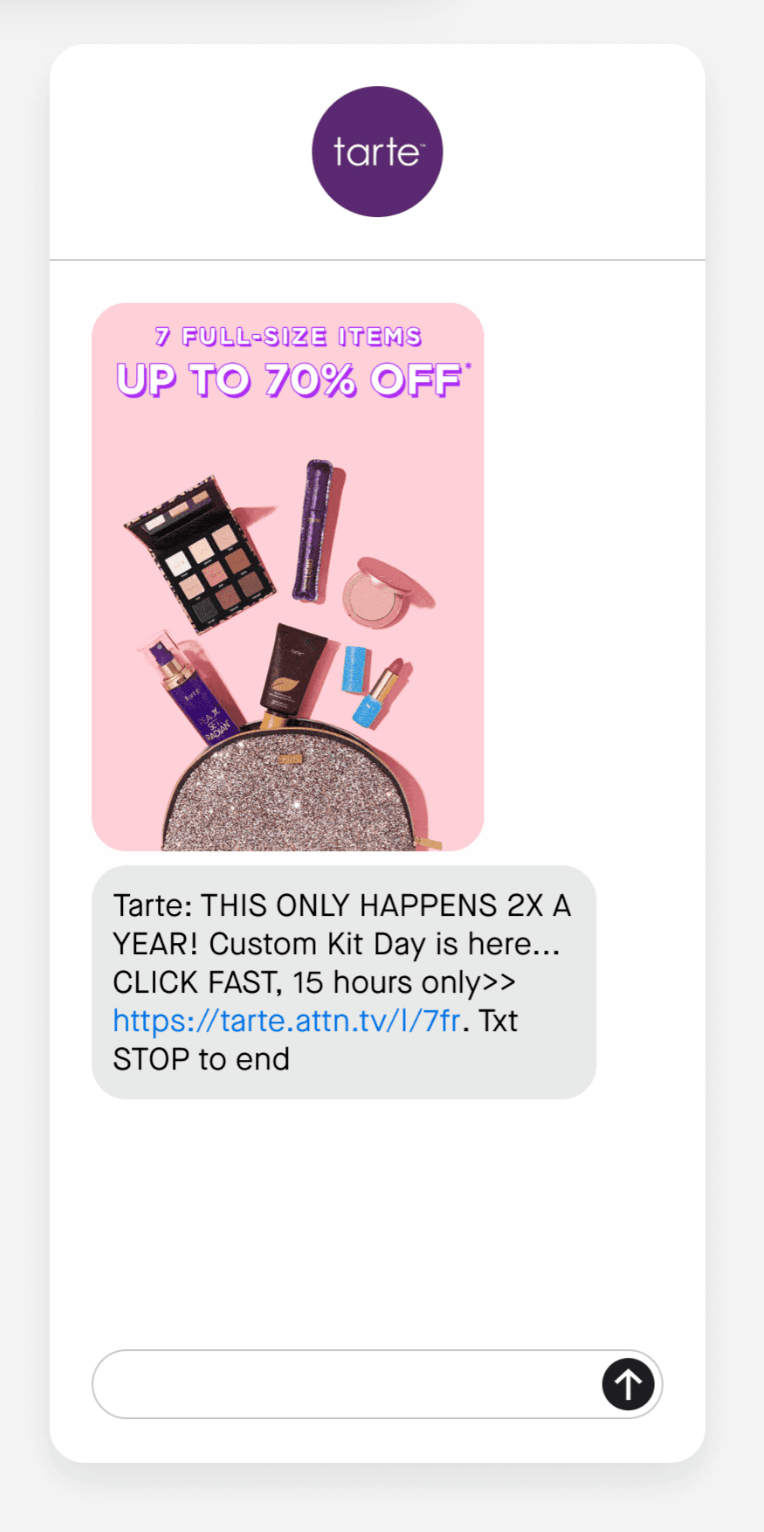
For example, Tarte allows you to build a custom kit for only two days in a year. So they trigger an SMS to let customers know to allow them to act fast and avoid missing a limited-time deal.
BFCM and major promotional windows work the same way. During high-intent periods, increasing SMS campaign frequency makes sense because customers are actively looking to buy. The channel’s immediacy turns a 24-hour sale window into a genuine urgency driver rather than a subject line competing with 40 other promotional emails.
The caveat is that SMS has a higher opt-out cost than email. Your SMS list is harder to rebuild because the opt-in barrier is higher. So the “send more” principle that works well for email needs to be calibrated for SMS. Increase volume during moments. Pull back during periods where there’s no natural reason to message.
C. SMS for CGC Collection
One of the highest-ROI uses of SMS has nothing to do with driving direct revenue. It’s collecting customer-generated content that feeds your creative pipeline.
At Kynship, we use structured email and SMS sequences to collect CGC from high-LTV customers, combining visibility from SMS with depth from email. The flow targets customers who have purchased at least once, excludes recent purchasers (typically the last 60 days), and offers store credit, usually around $100, in exchange for a short video testimonial.
The structure is straightforward: Email 1 introduces the initiative and shares a sample video. SMS 1 follows immediately. Two-day pause. Email 2 doubles down on the offer with another example. SMS 2 follows. Two-day pause. Email 3 is the final reminder. SMS 3 closes the sequence.
SMS is critical to this flow because it adds urgency and visibility that email alone can’t match. A customer might skim past the email or never open it. The SMS is much harder to ignore.
The content collected through this flow feeds directly into the creative pipeline that drives paid acquisition. Your best customers become your best copywriters. Customer-generated content is often the most authentic, least polished content you have, and it's frequently among the highest-converting creative in your ad account.
The ROI of SMS here isn’t measured in direct revenue attribution but in creative volume and ad performance. Every CGC asset collected through this flow is an asset that can be tested as a paid ad, and the cost of collecting it through an SMS + email flow is a fraction of what you'd pay a UGC creator for a comparable asset.
What to Deprioritize: Flows That Inflate Your Dashboard Without Changing Behavior
Most Klaviyo accounts have several flows running that generate attributed revenue without actually influencing whether a customer purchases. These flows look productive in reports but rarely show incremental impact when you run the holdout tests we described in Section 1.
The most common culprits are abandonment SMS, generic “we miss you” win-back messages sent on arbitrary timelines, and birthday or anniversary discounts sent to customers who weren’t going to buy anyway.
These flows aren’t harmful, but they’re just not worth the attention most brands give them. Every hour spent optimizing a browse abandonment SMS is an hour not spent improving your post-purchase to second-purchase bridge, which is where the real retention lift lives.
The practical test is simple: if you pause a flow for 60–90 days and the returning customer revenue doesn’t change, it wasn’t driving incremental impact. Reallocate your attention toward the flows that show genuine lift, and keep the low-impact flows running in the background without investing optimization time in them.
The Bottom Line
Not all SMS flows contribute equally to your financial outcomes. Focus your investment on the moments that actually change customer behavior: the post-purchase to second-purchase bridge, replenishment reminders timed to real consumption cycles, campaign SMS concentrated around product moments, and CGC collection flows that feed your creative pipeline.
Everything else can run in the background. You don’t want more SMS flows, you want to have the right flows doing real financial work.
Treat SMS As a Component, Not a Strategy
The biggest mistake brands make with SMS isn’t platform choice, timing, or copy. It’s treating SMS as a standalone channel with its own targets and reporting.
SMS only works as one component inside a financial system that starts with your P&L and ends with profitable growth.
Where SMS Sits in the Financial Forecast
At Kynship, every growth engagement starts with a financial forecast. We build targets around contribution margin, aMER, and profit goals. We figure out what the business can afford to pay for a new customer, and we reverse engineer the strategy from there.
That forecast is the foundation. Creative pipelines drive the traffic. Paid media on Meta and Google acquires new customers. And the retention layer, email, SMS, product experience, subscription, operational excellence, determines how much those customers are ultimately worth.
SMS lives in that retention layer. Its job is to increase the value of customers your paid media already acquired, which feeds back into the forecast and expands how aggressively you can acquire next month.
When you evaluate SMS this way, the questions change. You stop asking “What’s our SMS revenue?” and start asking “Is SMS measurably increasing our returning customer revenue, and if so, by how much does that raise our allowable CAC?”
That’s a fundamentally different conversation. And it’s the conversation that connects SMS to the financial outcomes your CFO actually cares about.
The Sequence Matters
SMS can’t compensate for broken acquisition economics.
- If you don’t have a financial forecast, no retention lever will give you confidence to scale
- If your creative pipeline isn’t producing enough volume and variety, SMS won’t fix that
- If your cost controls aren’t set properly, SMS won’t fix that either
The brands that get the most from SMS have their unit economics clear: Their creative system is producing at scale and their paid acquisition is running within defined guardrails. SMS then becomes the lever that multiplies everything those systems are already doing, by making each acquired customer worth more over time.
This is the same principle that applies to every retention tool. It’s a multiplier, not a replacement. Every improvement in returning customer revenue compounds across Meta, Google, creative testing, and offer strategy. But the compounding only works when the underlying system is healthy.
The Bottom Line
SMS is not a strategy. It’s a component inside a larger financial system. The brands that treat it this way, connected to their forecast, measured by incremental returning customer revenue, and calibrated to their product’s consumption cycle, are the ones that get real financial value from it.
How to Turn SMS Into a Measurable Growth Lever
If you’ve read this far, here’s where to start.
- First, run the holdout test from Section 1. Find out whether your SMS program is creating incremental returning customer revenue or just claiming credit for revenue that would have happened anyway. That single test will tell you more about the value of your SMS program than anything on your Klaviyo dashboard.
- Second, diagnose your consumption cycle. If your product supports frequent repurchase, invest in building behavior-based replenishment flows that time messages to actual usage patterns. If it doesn’t, keep SMS lightweight and focus your retention energy elsewhere.
- Third, audit your flows. Identify which ones show genuine incremental lift and which ones are running on autopilot without changing customer behavior. Concentrate your optimization time on post-purchase sequences, replenishment reminders, and CGC collection. Let the low-impact flows run in the background.
- Fourth, connect your SMS metrics to your financial model. Stop reporting SMS revenue as a standalone number. Start reporting incremental returning customer revenue from SMS and tie that number to your allowable CAC and contribution margin targets. That’s how SMS becomes a lever your finance team can plan around.
The brands that scale past $10M, $25M, $50M build systems where every lever, forecasting, creative, acquisition, and retention layer works together toward the same financial outcomes.
SMS is one piece of that system. When it’s connected to the right metrics and aligned with your product’s natural consumption cycle, it makes everything else in the system work harder.
At Kynship, we help DTC brands between $2M and $100M drive profitable new customer growth, from the forecast to the creative to the acquisition. If you want to understand how retention is impacting your CAC ceiling and spend capacity, we can walk through your numbers together.
Or, if you found this guide useful, subscribe to Cut the CAC, our biweekly newsletter focused on what's actually working in DTC right now.
The 10 Eccommerce Tools We Use To Produce 3,000+ Ads Per Month
Six ecommerce tools and four AI workflows we use to produce 3,000+ ads per month across our DTC clients. Pricing, features, and how we use each one.
5 Ecommerce Website Optimization Mistakes That Kill DTC Growth
These five website optimization mistakes cost DTC ecommerce brands millions each year, and as margins tighten, it's important to plug the leaks.
Bi-weekly tips to reduce your CAC
Join thousands of DTC operators and subscribe to Cut the CAC for insights from the Bottom Line Podcast and Kynship's growth strategies.



We use cookies to optimize our website and your experience with Kynship. But, like our democracy, you're in control. View our Privacy Policy for more information.

Privacy is important to us, so you have the option of disabling certain types of storage that may not be necessary for the basic functioning of the website. Blocking categories may impact your experience on the website. More information