

Hold Up Displays Scales Revenue 43% In 12 Months While Maintaining Efficiency

Overview
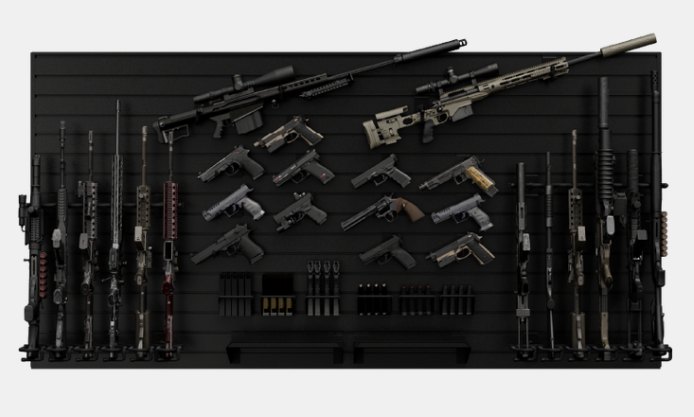
Hold Up Displays is a US-based manufacturer of premium firearm wall display systems. They build every product in-house and sell across their own BigCommerce storefront and Amazon.
By mid-2025, Hold Up Displays was in an enviable but frustrating position. The business was profitable, the brand had a loyal customer base, and the team was sitting on a large library of content, with hundreds of ads and a seeding list of hundreds of creators.
What they didn't have was a way to spend more without giving up efficiency.
Because Hold Up Displays manufactures everything themselves, growth isn't free. More volume means more capacity, more equipment, and more operational complexity. Leadership wasn't interested in growth for growth sake. They wanted profitable, controlled scale bringing in more new customers at an order value and efficiency that made sense for a manufacturer.
Kynship understood the assignment.
In our first twelve months with Hold Up Displays, Kynship scaled spend by 41% while increasing efficiency, resulting in a 46% jump in new customer revenue and a 43% jump in total revenue.
"Kynship did what they said they'd do, which is rarer than it should be in this business. It's great to be partnered with a team who cares, listens, and actually makes changes based on our feedback."


The Starting Point
Hold Up Displays came to Kynship already doing a lot right. They had adopted cost-control bidding on their own and were seeing early results. They had also produced a remarkable volume of creative (nearly 400 ads in the previous 90 days) and had a seeding list of hundreds of creators ready to activate.
The constraint wasn't creative, and it wasn't the media buying philosophy.
Where they needed help was with their offers.
A single entry-level offer was carrying almost the entire ad account. With only one primary way into the brand, Meta was optimizing toward the same low-threshold purchase over and over. The account was pulling in orders below the store's true average order value, which capped how much the business could profitably spend to acquire a customer, and by extension, capping total spend.
Kynship identified that the brand’s top-spending video ad was stopping the scroll well above benchmark on attention, but converting below benchmark on click-through. People were interested and responding to the creative, but losing momentum at the offer.
Alongside the offer bottleneck, our audit surfaced the usual structural drag of an account that had scaled fast: multiple campaigns competing on the same offer, an existing-customer budget allocation that should have been zero, outdated audience exclusions, and view-through attribution inflating reported performance.
Additionally, despite a large roster of creator relationships, Hold Up Displays had never run a single whitelisting campaign.
In short, this was a brand with a strong base but a low ceiling on their existing trajectory. So we focused on restructuring the trajectory to raise that ceiling and enable efficient growth.
How Kynship Enabled Efficient Growth
Our goal at Kynship isn't to point to numbers in your ad account after a year and say, "Look how great we are at running your ads." Our goal is to point to your P&L in a year and say, "Look at how successfully your business has grown." That means our approach has to start with the P&L.
1. We reverse-engineered targets from unit economics.
Kynship started with Hold Up Displays' P&L, using a cohort-based forecast built around the brand's real contribution margin. We set clear efficiency targets that every campaign and creative would be held to. Most importantly, rather than chasing a revenue number, spend was tied directly to profitability. This gave the brand a single, objective standard for what "working" meant, and it aligned Meta spend to bottom-line outcomes instead of vanity metrics.
2. We set efficiency targets channel by channel, not just in aggregate.
A blended efficiency target only works if every channel underneath it is pulling its weight. When one channel spends against a soft target, it quietly drags down what the whole business can profitably do, and the channels that are working get squeezed to cover the difference.
That was the case here. Google and Amazon were spending against targets well below where they should have been, while Meta had been held to a stricter standard than it actually needed. Meta looked like the star, but in aggregate the brand was overpaying for the same customers, and the one channel with real headroom was the one being held back.
So we set an efficiency target for each channel individually, tied to the same contribution-margin math behind the blended goal. On Google, that meant separating brand from non-brand and holding each to its own standard. On Amazon, it meant right-sizing spend against what the channel was actually returning. Then we carried those targets down to the campaign level. Because Meta optimizes on a seven-day click window and Hold Up sells a high-consideration, made-to-order product, plenty of buyers click well before they buy. We measured the gap between what the ad account reports in that window and what those clicks are actually worth, and set cost caps at the SKU level that account for it.
As a result, Hold Up Display immediately stopped overspending on Amazon and Google customers and was able to substiantially increase Meta spend with zero drop in efficiency.
3. We helped build an offer ladder.
Instead of one entry-level offer carrying the account, Kynship helped Hold Up Displays introduce a sequence of offers and gift-with-purchase mechanics layered onto evergreen campaigns, expanding the ways a new customer could enter the brand and testing each offer systematically by outcome.
This approach is specific to cost-controlled media buying. Under cost controls, you don't spend more by deciding to spend more. You spend more by improving order value and conversion, which raises what you can profitably pay to acquire new customers. A broader, better-tuned set of offers was the fastest way to move those levers, so that's where we focused.
4. We helped activate existing content assets.
Many of our DTC clients need Kynship to build out their creative pipelines, but Hold Up Displays had already done a great job of building a solid base of creative assets. The problem was that they weren't being used to their full potential. Many weren't being used at all.
Kynship put hundreds of underused and never-run assets into rotation, added AI-produced statics, influencer seeding, and creator content, and established a consistent cadence of fresh creative into the account. We also helped their internal team realize that content that's new to the ad account does the job, even when it isn't new to the brand.
5. We cleaned up the ad account.
Kynship cleaned up the ad account to consolidate campaigns by offer, so each one had a clean read instead of competing against itself. Attribution was moved to click-based reporting so the numbers reflected what the ads actually drove. We refreshed stale audience exclusions and excluded existing customers so Meta could focus ad spend on acquiring new customers. None of this is sexy or glamorous, but caring about stuff like this is why we were able to get big results for Hold Up Displays in their first 12 months with us.
Results
Over their first twelve months with Kynship, Hold Up Displays scaled spend hard and got more efficient while doing so, a combination that most brands are told is out of reach.
🔥 Revenue Grew 43%
🔥 New Customer Revenue Grew 46%
🔥 Ad Spend Scaled 41%
🔥 Ad Spend Efficency Impoved 3% While SCALING.
🔥 100% Of Growth Came From Owned Channels
Spend went up 41% while improving efficiency.
Most agencies grow spend by giving up efficiency. Hold Up Displays did the opposite. aMER improved from 5.20 to 5.38 even as ad spend grew by nearly 50%. That's the whole thesis of cost-controlled scale, proven in a single account.
New customers grew without cheapening the order.
New customer revenue grew 46% while new-customer order value held steady at a premium level, meaning the growth came from reaching more customers, not from discounting the average order down. At the same time, returning-customer order value rose 27% as repeat buyers came back for larger, often custom-configured orders, which is exactly what we wanted for the high-consideration, made-to-order nature of Hold Up Displays’ products.
Growth came from owned channels.
Thanks to the work we did setting efficiency targets for each channel, revenue gains came from Hold Up Displays’ owned channels where profit margins were higher. BigCommerce revenue increased by 47% and email and phone revenue went up 96% while Amazon held flat. The channel-by-channe numbers demonstrate that this growth didn't come from a marketplace halo effect or a lucky new customer source. This was a very focused, very deliberate Increase in net-new customers coming to the site via the brand’s preferred channels.
🔥 BigCommerce Grew 47%
🔥 Email & Phone Revenue Grew 96%
🔥 Amazon (Least Profitable Channel) Stayed Flat (-2.4%)
The Bottom Line
Hold Up Displays came to us with a set of needs that most growth agencies would have fumbled. Improving ads or scaling creative weren’t going to drive the efficient growth the brand needed. They had a ceiling on their existing business structure. One entry-level offer was carrying the account, which capped how much they could profitably spend, and that capped how much they could grow.
Kynship raised the ceiling. We tied spend to the P&L, helped roll out an offer ladder, put their existing content to work, and cleaned up the account so Meta could focus on new customers.
As a result, revenue grew 43% in just 12 months, and new customer revenue grew 46%, both at improved efficiency.
As a manufacturer, growth adds real cost and real complexity, so this growth had to be profitable, and that’s the type of challenge we excel at. Most brands are told they have to pick between scale and profitability. Hold Up Displays got both.
Think you're hitting the same ceiling?
If your brand has strong creative and a loyal customer base but can't seem to spend more without giving up efficiency, the problem usually isn't your ads. It's structural. And it's fixable.
Kynship helps DTC ecommerce brands between $2M–$100M break through growth plateaus by reverse engineering from both top and bottom line goals, building scalable creative systems, and driving new customer growth profitably. If you’d like help growing your brand efficiently this year, fill out the form below
Why choose The Kynship System?


We use cookies to optimize our website and your experience with Kynship. But, like our democracy, you're in control. View our Privacy Policy for more information.

Privacy is important to us, so you have the option of disabling certain types of storage that may not be necessary for the basic functioning of the website. Blocking categories may impact your experience on the website. More information