
5 DTC Marketing Success Stories From The Last 5 Years

.avif)
.avif)
.avif)
Over the last five years, DTC has gone through one of the most dramatic shifts in its short history.
What worked in 2018 or even 2021, cheap acquisition, forgiving algorithms, a handful of winning ads, no longer works the same way today. CAC is higher. Creative burns out faster. Attribution is noisier. And brands are expected to manage more channels, more SKUs, and tighter margins than ever before.
Yet some brands didn’t just survive this shift. They scaled aggressively through it.
They didn’t do it with hacks or secret channels. They did it by identifying the real bottleneck in their business at the right moment, and fixing that bottleneck with focus and discipline.
In this article, we’ll break down five DTC marketing success stories from the last five years. Each one highlights a different growth constraint, creative fatigue, channel saturation, retention ceilings, SKU complexity, and shows how the brand overcame it.
You’ll see:
- What was holding each brand back
- The specific strategy they used to break through
- The results that followed
- The core lesson you can apply to your own business
These aren’t highlight reels. They’re case studies in how growth actually happens when conditions get harder.
1. Purdy & Figg Grow From £452K to £50M in Three Years
Purdy & Figg is a UK-based natural cleaning products company. Purdy Rubin and Charlotte Figg founded the company in 2018 to bring more clean, natural, and environmentally friendly cleaning products to the world.
In 2021, they started their partnership with Kynship, implementing the influencer seeding and creative content generation strategy. In the first year, the revenue was £452,000. By 2024, the growth was astonishingly exponential, with annual sales climbing to £50 million (that’s a 10,900% increase!).
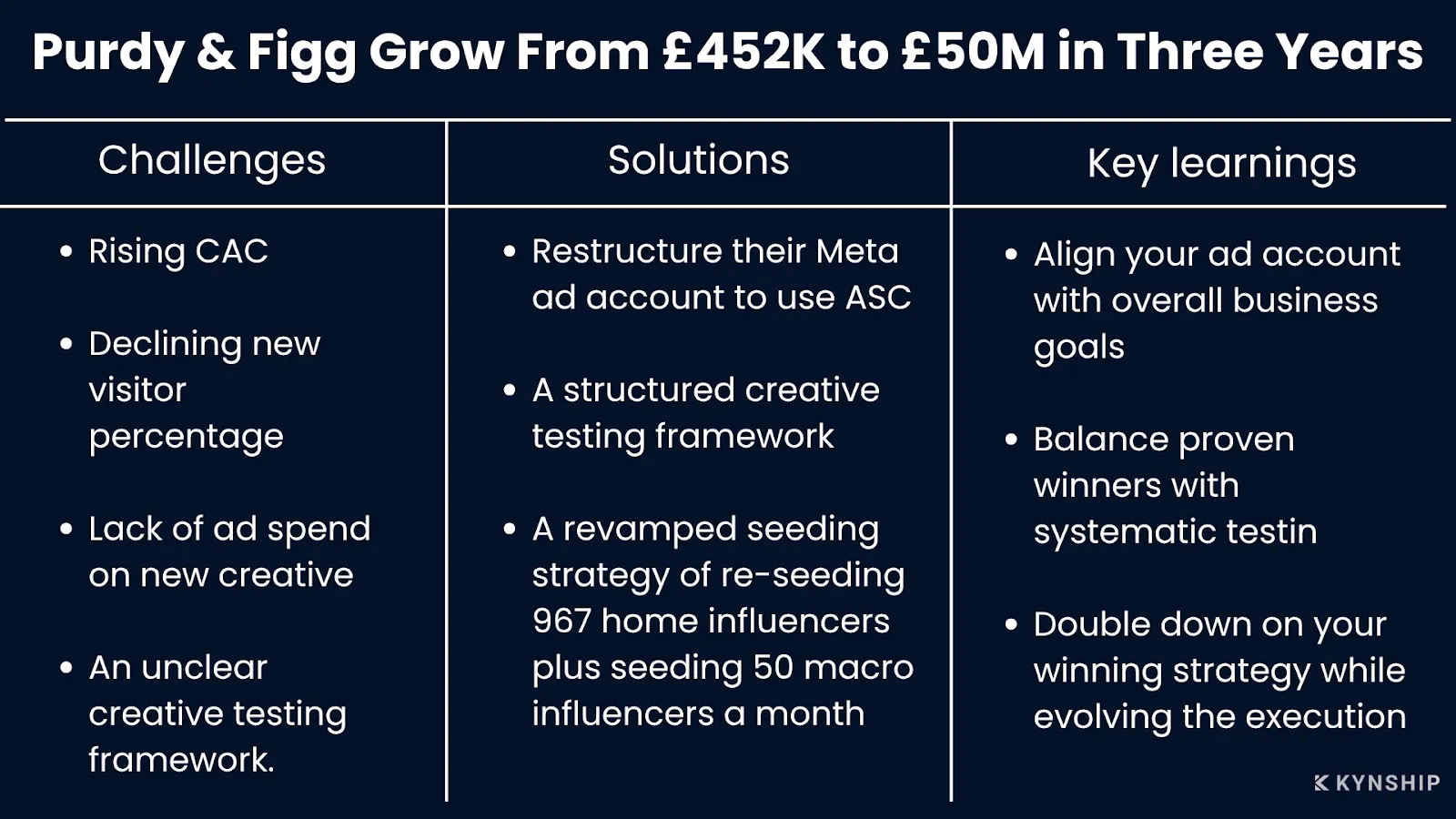
But new growth meant new challenges. As 2024 progressed, Purdy & Figg saw rising CAC, declining new visitor percentage, lack of ad spend on new creative, and an unclear creative testing framework.
Here’s Kynship’s strategy to overcome all these obstacles, after working with the brand for over three years:
- Restructure their Meta ad account to use Meta Advantage Shopping Campaigns (ASC) so the company can maintain efficiency even with rising CAC
- A structured creative testing framework with a 60/40 split—60% focus on top performers and 40% on testing new angles and formats
- A revamped seeding strategy where Kynship re-seeds 967 home influencers based on our 1,000 influencer quarterly target, plus seeding 50 macro influencers a month
The results from these changes speak for themselves:
- 586% increase in ad spend
- 772% increase in new customer revenue
- 61.14% reduction in customer acquisition costs (CAC)
Key Takeaways:
- Align your ad account with overall business goals: Kynship’s strategy includes financial forecasting—which allows them to get a big picture view of the whole business and suggest changes to the ad account that’d be able to meet targets. When Purdy & Figg ventured into new ad channels, Kynship pivoted to align ad account targets with bottom-line goals—which also helped understand how Meta is performing amidst new channel integrations.
- Balance proven winners with systematic testing: To fight creative fatigue, Purdy & Figg focused more creative production on top performers. It’s important to test new creatives, but just as (if not more) important to double down on what’s already working.
- Double down on your winning strategy while evolving the execution: Seeding has been a constant driver of growth for Purdy & Figg. But Kynship helped the team modify its implementation to see better results. If a particular strategy has driven your initial growth, scale it strategically rather than abandoning it.
2. MUD\WTR Builds a $400M Brand in Less Than Five Years
MUD\WTR is a health and wellness brand that sells coffee alternatives. Shane Health started the company in 2018 to help people rethink their relationship with caffeine. The company generated more than $16 million in revenue in 2020.
The company used a variety of marketing channels to achieve this growth. They have invested in ads on TikTok and Meta, along with educational content on YouTube.
Paul DeJoe, the company’s COO, said they saw great returns with Shane’s founder videos and influencer collaborations. Danielle Murphy, who’s been handling the company’s partnerships, manages all the creator side and ensures an excellent CAC from this channel. She focuses on long-term influencer collaborations that feel authentic to the brand and reflect the company’s values.
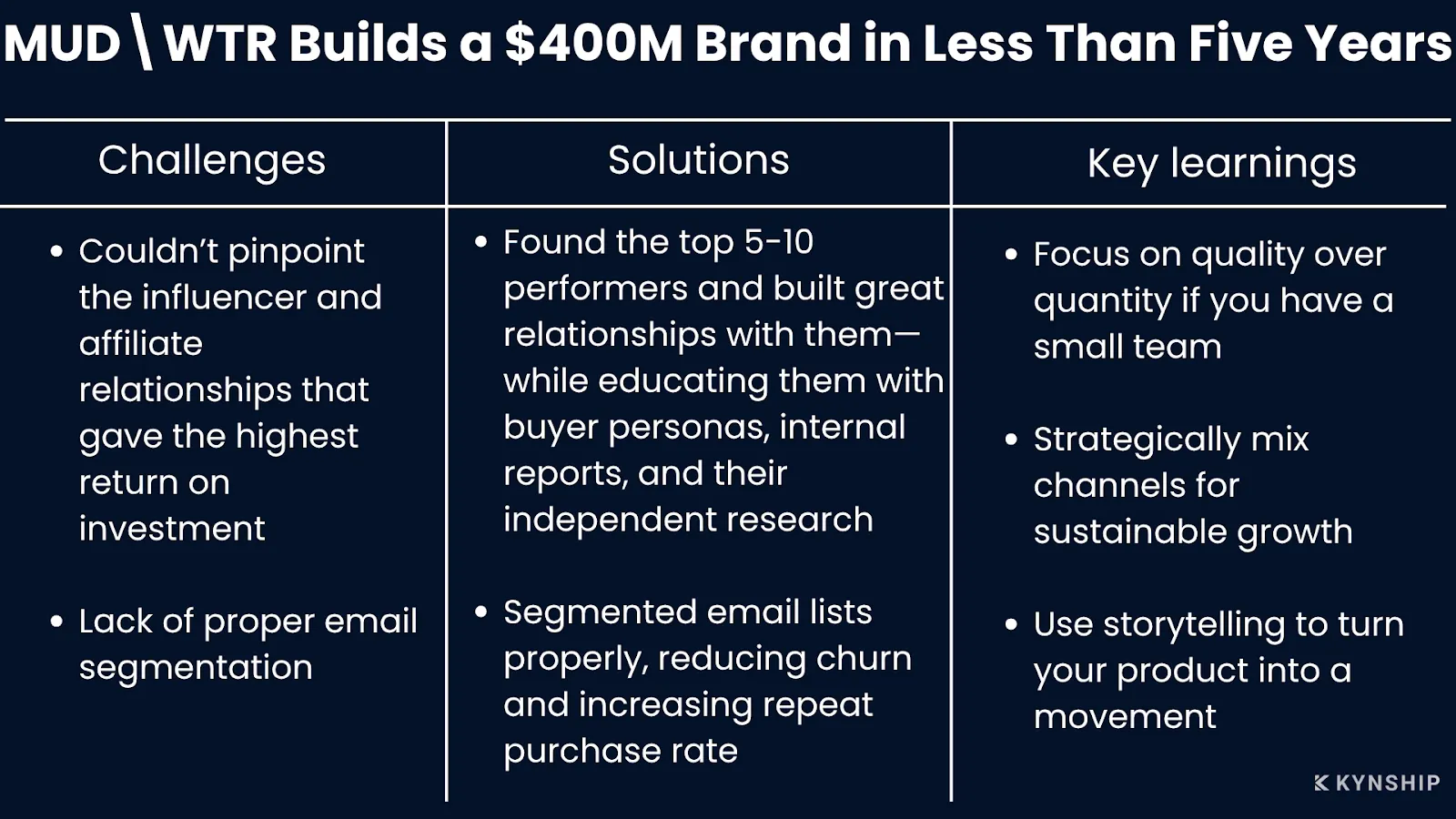
The challenge arose when Danielle couldn’t pinpoint which partnerships delivered the highest ROI. She used Squaredance to determine this and found over 170 great performers. This was too much for the team to manage at that time, so the company focused on the top 5-10 partners aligned with MUD\WTR’s goals.
With the focus on quality over quantity, Danielle was able to invest properly in every relationship. She spoke with each partner a few times every week to educate them on MUD\WTR’s buyer personas, internal reports, and their independent research. After doing this for a year (2022 to 2023), the company saw great results:
- 469% increase in revenue per partner
- 41% increase in average payout
- 280% jump in annual sales
- 74% increase in CVR
Affiliate collaborations are the company’s second-highest revenue-generating channel as of 2024.
Along with this, MUD\WTR has also invested in other channels—including email marketing, blogs, and podcast ads. By properly segmenting their email list, they reduced churn by 11% and increased the repeat purchase rate by 10%. Paul has also reported achieving a higher LTV with podcast ads. But this only happens after advertising on the same pod at least three times.
These acquisition channels work in tandem with landing page optimization and cost reduction to achieve the best results. For instance, they used Motion (a reporting tool) to reduce their creative costs by 70% and optimized their landing page to drive a 62% increase in conversion rate and 33% improvement in CPAs.
Key Takeaways:
- Focus on quality over quantity if you have a small team: MUD\WTR chose to nurture a few authentic, well-aligned influencer relationships rather than spread themselves thin. If you’re a small team strapped for time and resources, double down on high-performing partnerships that drive the most ROI. When you have more resources, you can expand without compromising quality.
- Strategically mix channels for sustainable growth: MUD\WTR didn’t just focus on influencer collaborations. They combined those efforts with a variety of channels—email marketing, podcast ads, and paid social—to amplify their impact. Coordinate multiple channels with consistent messaging so they can feed off of each other.
- Use storytelling to turn your product into a movement: MUD\WTR didn’t just position itself as an alternative to coffee. They created a narrative of a wellness ritual—which helped the brand stand out in a crowded market and become more memorable. Turn your branding and product into a movement to build an emotional connection with your current and future buyers.
3. Days Brewing Increases Its Sales by 160% in One Year
Days Brewing is one of the fastest-growing alcohol-free beverage companies in the UK. Its annual sales in 2023 were £290k, which jumped to £723k in 2024. They saw an even bigger jump of 200% in website sales from 2022 to 2023.
Mike Gammell and Duncan Keith began their company right at the cusp of the 2020 lockdown. They used the time during COVID-19 to perfect their product—ensuring their non-alcoholic beer tastes…just like beer. Minus the hangover and harmful effects of alcohol.
Their primary growth channel has been their TikTok marketing. They went viral after participating in the Tube Girl Trend, leading to a whopping 432% increase in web traffic and their best-ever week of sales.
Many of Days Brewing’s TikTok content features the founders themselves (including the viral video) and all of it is personality-rich. At one time, they were the most popular/talked-about beer brand on the platform. It makes sense for the company to go all-in on TikTok as their primary target customer base (health-conscious Gen Z folks) uses the platform to discover new brands.
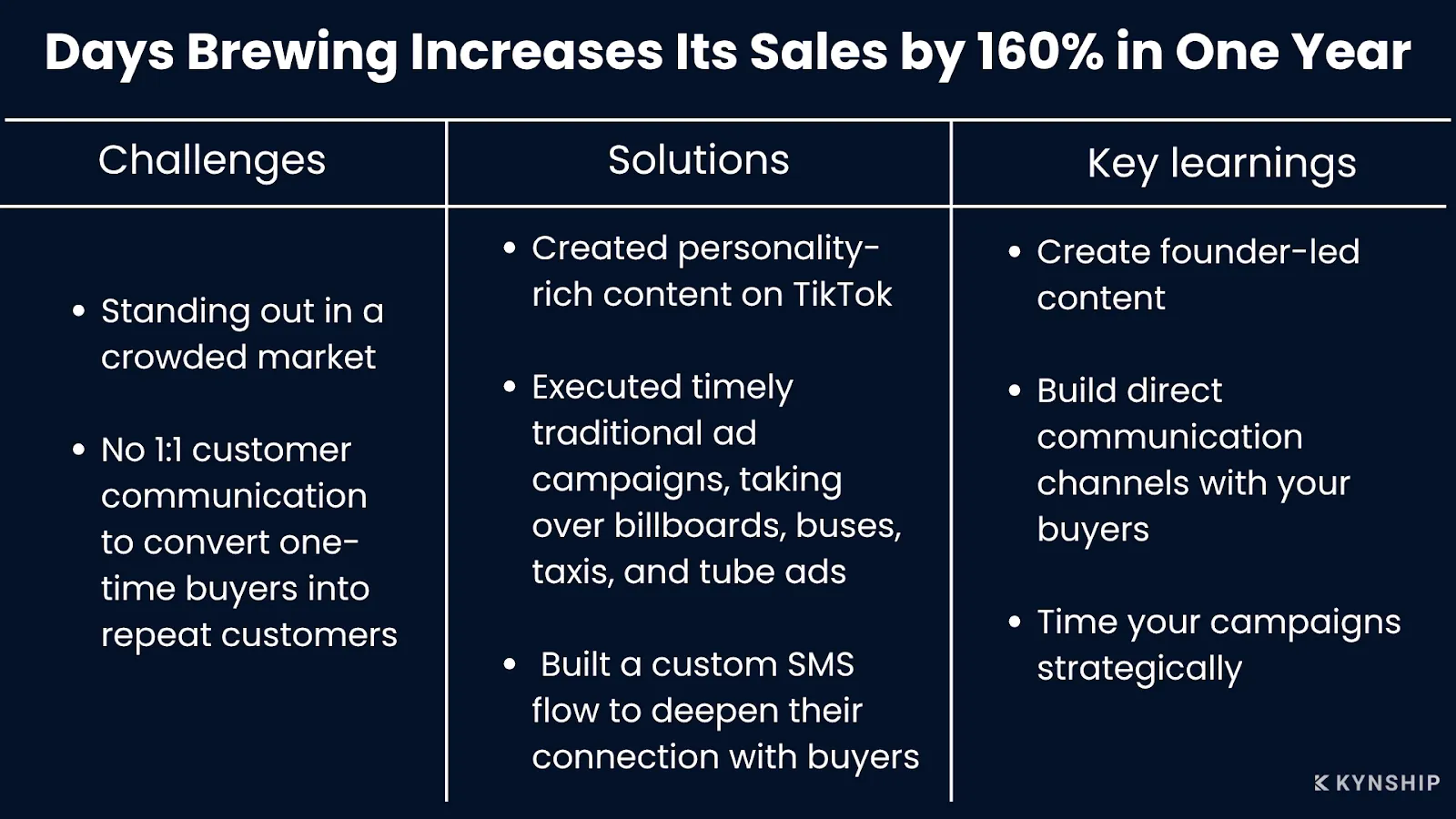
Days Brewing struggled to build a 1:1 communication channel with its customers to turn them into repeat buyers. To improve this, they partnered with Blueprint to create a custom SMS flow to deepen their connection with buyers. After implementing this, they saw:
- 44.8% reply rate
- £2.24 revenue per message
- 17% abandoned carts recovered
- 5x ROI
They’ve also run more traditional ad strategies, like their out-of-home campaign in January: they took over billboards, buses, taxis, and tube ads in Dry January to convince their future buyers to skip alcohol without missing beer. They had 31 different images, a unique one for each day of the year. These ads reportedly reached 26 million people.
Key Takeaways:
- Create founder-led content: Days Brewing always puts its founders front and center in its social channels. Doing so can help buyers feel more connected to the brand and build sticky recognition.
- Build direct communication channels with your buyers: Investing in building 1:1 relationships with your customers can go a long way. Invest in tools that can help you build personalized flows so you can focus on retaining customers in addition to acquiring new ones.
- Time your campaigns strategically: Days Brewing launched the Dry January campaign when most people are thinking about their health and considering quitting alcohol, helping them gain much more visibility. Launch strategic campaigns when your audience is already looking for solutions like yours.
4. Obvi Reaches $40M Revenue in Three Years
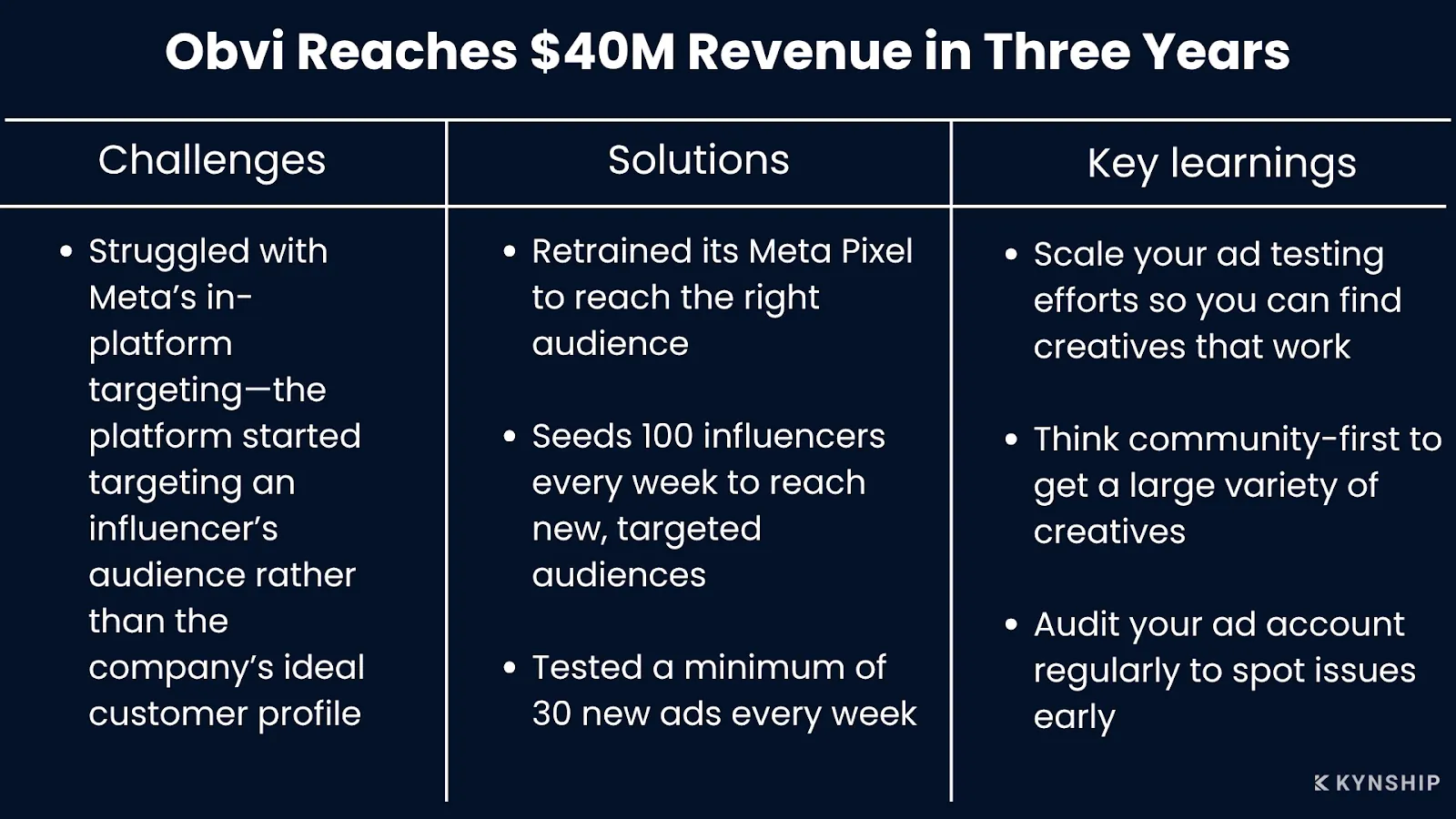
Obvi is a collagen supplement brand that has reached $40M in revenue in 2024. In their first year of business (2019), their revenue was $178K. The following year, they did $1.2M. In year two, the founder (Ron Shah) went all in and shut down his agency.
The company has been bullish on investing in Meta ads from day 1. They began with a $100 budget for Facebook ads and kept pouring more as they reached their desired ROAS. As of 2024, they test a minimum of 30 new ads every week, which can be repurposed to nearly 75 ads via new angles and iterations.
Alongside this, they’ve also been actively working on their influencer marketing efforts, seeding nearly 100 influencers every week. They’ve built a creative flywheel that also uses influencer, user, and customer-generated content in their ads.
It wasn’t always this smooth sailing, though. Obvi struggled with Meta’s in-platform targeting when the platform started targeting an influencer’s audience rather than the company’s ICP. This continued for a year before the company brought in Proxima AI to retrain its Meta pixel. Once they refined their audience, Obvi also worked to reach new audiences to expand its reach. This expansion, combined with retargeting, led to:
- 2.3x increase in Meta ad spend
- 12.1% lower new customer CPA
- 7.5% increase in new customer ROAS
Obvi also runs an affiliate program for its influencers and customers. Smaller influencers get 30% commissions on all sales, while big influencers receive 50%. They also offer 50% commission to their customers in exchange for an honest video review.
All of this works in tandem with their promotional offers on the website, an active Facebook community (with over 117K members!), targeted SMS & email marketing, postcard marketing, and their bold branding.
Key Takeaways:
- Scale your ad testing efforts: Running more ads can allow you to test more creatives and find what works. This is crucial for maintaining and improving your Meta ad performance. Build a creative flywheel so you’re never running out of new ads.
- Think community-first: Obvi’s all-in on community—this network helps them turn customers into affiliates and one-time buyers into lifetime customers. Focus on initiatives that help you reward your buyers and foster a community.
- Audit your ad account regularly: Consistent, accurate creative reporting can help you identify your best-performing creatives and spot issues before they become major inefficiencies. Learn more about how you can practice creative reporting for your ad account—what you should evaluate and why.
5. Wildbird Multiplies Its Revenue by 10X Over Two Years
Husband and wife duo Taylor and Nate Gunn started WildBird in 2014 as a side hustle while they were expecting their first child. Influencers and Instagram marketing drove their early growth. So, they didn’t have to spend on ads for the first four years.
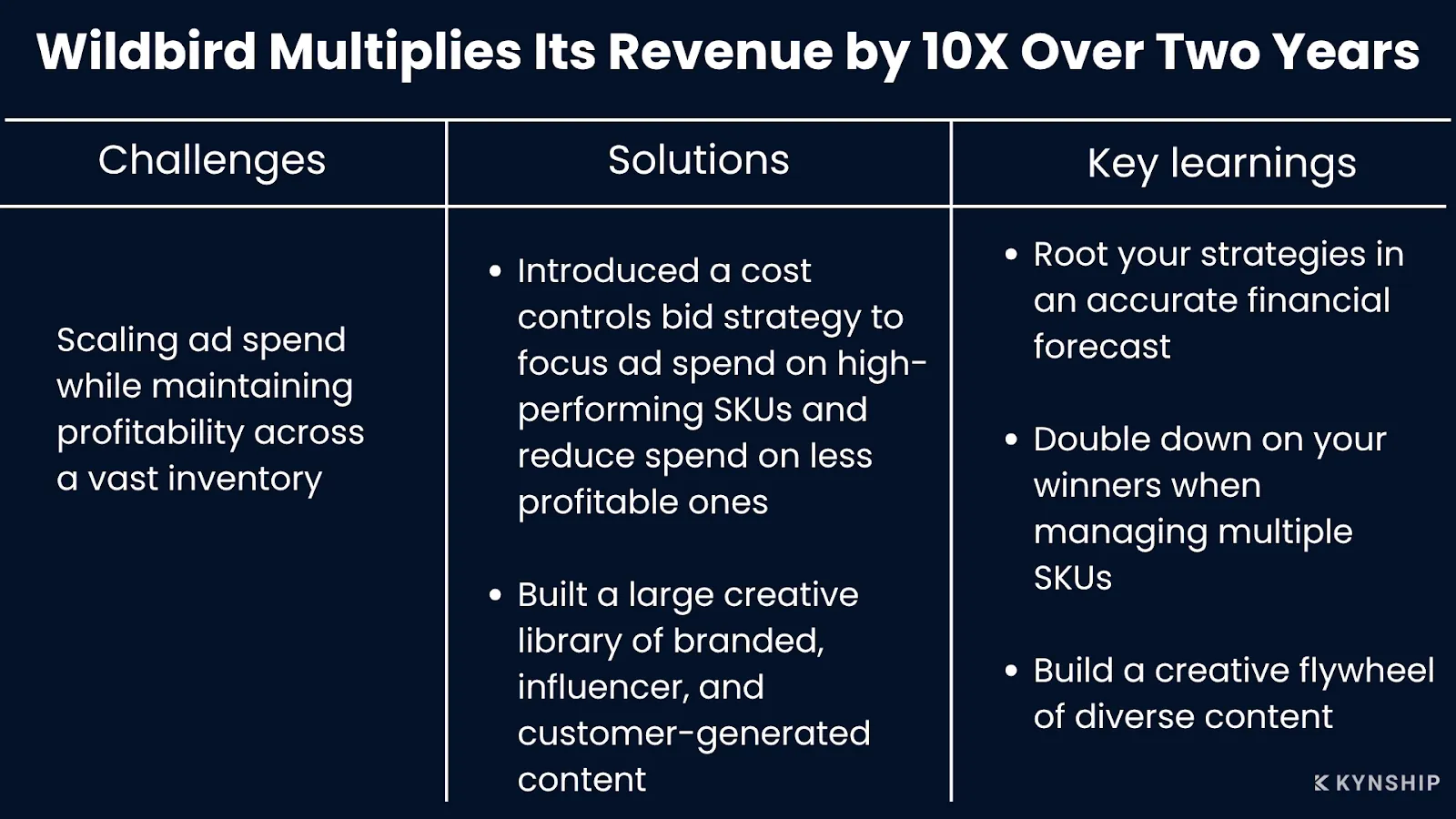
After dabbling in advertising for a little while, they ran into a common problem for every DTC brand: scaling ad spend while maintaining profitability across a vast inventory.
Here’s how Kynship helped them:
- Aligned with the company’s financial goals by creating a financial forecast for WildBird based on the revenue and cost data of the last two years
- Introduced a cost controls bid strategy to focus ad spend on high-performing SKUs and reduce spend on less profitable ones
- Built a creative flywheel of branded, influencer, and customer-generated content
WildBird hit eight figures soon after. They also witnessed:
- aMER over 11%
- 30% contribution margin
- 17.5% increase in profits
- Increase in ad spend by 92.47% YoY
- Increasing new customer revenue by 115%
Alongside this, the company also improved its SEO efforts, increasing its domain rating by 10% and organic traffic by 649%.
Key Takeaways:
- Root your strategies in an accurate financial forecast: Use historical revenue and cost data to create a clear financial model that aligns your ad spending with actual profitability goals, ensuring every dollar spent contributes to sustainable margins.
- Double down on your winners: When managing multiple SKUs, implement cost controls that funnel budget toward high-performing products and cut spending on unprofitable ones.
- Build a creative flywheel of diverse content: Combine branded, influencer, and customer-generated content in your ad account to keep creative fresh and performance steady.
The New DTC Growth Playbook For 2026
At first glance, these five brands look very different.
- Different categories
- Different audiences
- Different channels
- Different creative styles
But underneath the surface, the patterns are unmistakable.
Every brand that broke through a major growth ceiling did the same few things well:
- They aligned marketing decisions with financial reality
- They scaled creative volume instead of chasing perfect ads
- They focused on the channels that actually drive revenue at their stage
- They built repeatable systems instead of relying on one-off wins
Most importantly, none of them grew by accident.
They grew by adapting their strategy to a new DTC environment, one where efficiency matters more, creative cycles are shorter, and gut-driven decisions are punished faster than ever.
And this is where many brands get stuck.
They read case studies like these and try to copy individual tactics. A new channel. A new creator strategy. A new offer. A new tool.
But tactics aren’t the lesson.
The lesson is that the DTC growth playbook itself has changed.
What worked five years ago is no longer enough. The bar for forecasting, creative systems, cost controls, retention strategy, and brand building is much higher now, and it will be even higher in 2026.
That’s why we put together The New Ecommerce Growth Playbook for 2026.
In this deep dive built from our work driving $350M in attributable revenue over the last 5+ years, we'll show you:
- Why marketing-led growth is being replaced by finance-led growth
- How brands should structure creative, Meta, Google, retention, and brand going forward
- What you should stop doing immediately
- And what winning DTC brands are building now to stay ahead
If these five stories show what’s possible, the 2026 playbook shows how to get there in today’s market.
What Should DTC Brands Look For in a Growth Partner?
Most agencies run a channel. A growth partner takes responsibility for the outcome. Here are the 5 criteria that separate the two.
How Do DTC Growth Agencies Use Forecasting to Guide Ad Spend?
Growth agencies turn your profit goal into an aMER target, then into the cost controls that guide daily ad spend. Here's the full chain.
Bi-weekly tips to reduce your CAC
Join thousands of DTC operators and subscribe to Cut the CAC for insights from the Bottom Line Podcast and Kynship's growth strategies.



We use cookies to optimize our website and your experience with Kynship. But, like our democracy, you're in control. View our Privacy Policy for more information.

Privacy is important to us, so you have the option of disabling certain types of storage that may not be necessary for the basic functioning of the website. Blocking categories may impact your experience on the website. More information